
Exploring Peruvian Culture
Shaping Cultural Experiences
Travel has been an integral part of my life since I was a young child. I grew up in a multicultural, bilingual home in the Netherlands with a Polish mother and a Dutch father. My
Update & BBC News Link
A brief update: One interview video will be uploaded tomorrow evening. I believe the BBC News One-Minute World News provides well-balanced reporting of news, hence why I wanted to share it. Top stories on May
From Nigeria to Boston
http://www.youtube.com/watch?v=9VNkCazT_T4&feature=youtu.be
When you first meet Oluwagbeminiyi Osidipe, you encounter a very vibrant, friendly, and unique personality. Oluwagbeminiyi or Niyi – as she shortened her name for simplicity – was named by her mother, who had a “very personal experience” when she had her, Niyi explained. Niyi is a Yoruba Nigerian transplant who arrived in the U.S. in 2006. As one of the most densely populated (West) African countries, Nigeria derives its name from the river that spans its land. To the South, it borders the Gulf of Guinea to the Atlantic Ocean. Originally colonized by the British, Nigeria gained independence in 1960. Its main ethnic groups are the Hausa, Igbo and Yoruba, who speak English and their own respective languages, while major religions include Islam, Christianity and indigenous beliefs. Niyi shares her story, her views on politics, cultural differences she’s embraced with humor, and what we can learn from each other by expressing curiosity. Her message is simple: travel enriches us through its exposure to new cultures, and enables us to grow.
Mark Twain on Travel
“Travel is fatal to prejudice, bigotry, and narrow-mindedness, and many of our people need it sorely on these accounts. Broad, wholesome, charitable views of men and things cannot be acquired by vegetating in one little corner of the earth all one’s lifetime.” (American author Mark Twain, Innocents Abroad).
Have you had the opportunity to travel (extensively, within your country, or even once abroad)? Can you relate to Twain’s sentiments? How does travel enrich us?
Pleasing The Taste Palate

Food has the wonderful quality of uniting us no matter where we are. There is nothing partisan or narrow-minded about food. It simply invites us to indulge, create recipes, and share with others. Two of my favorite Polish dishes (included in collage) are pierogies and barszcz czerwony – a beetroot soup – served on Christmas Eve in Poland. How does food bring us together? What are some of your favorite dishes and why? Can food trigger memories?
Stereotypes: Truth or Fiction?
DEFINING STEREOTYPES: “An idea or statement about all of the members of a group or all the instances of a situation.” (Merriam-Webster). Stereotypes enable bias and preconceived notions to perpetuate, but can also reveal valid
Annual Human Rights Report
“The world changed immeasurably over the course of 2011. Across the Middle East, North Africa, and far beyond, citizens stood up to demand respect for human dignity, more promising economic opportunities, greater political liberties, and
Euro Crisis & Emerging Stereotypes
Brief Crisis Breakdown Since the onset of the global financial crisis, or Great Recession, in 2007, the Eurozone has feared impending growing global debt levels, as well as sovereign debt within European countries themselves. In
Remembering Tiananmen
Today marks the 23rd anniversary of Tiananmen Square pro-democracy protests in Beijing, China. Inflation, a lack of career prospects, the fall of Eastern European communism, and political corruption, are all said to have fueled anger
Coffee's Uniting Power
A cup of coffee can bridge cultural gaps. At least, that’s what Gizem Salgicil White, founder of Turkayfe.org, believes. Her organization aims to create awareness of Turkish culture, particularly within America. Gizem is a Turkish native,
Today’s guest post is by Aparna
 Traveling to a new country is almost always an exhilarating and incredible experience. You can have an idea of what to expect from a bit of reading beforehand, but there are some things that you get only from spending time in the country. The wonderful and weird intricacies of a culture are truly only experienced firsthand!
Here are 11 things I discovered about Peru when I spent 2 weeks there:
1) There are over 3000 varieties of potatoes in Peru! They come in varying shapes, sizes, colors, and are included in every meal. Breakfast might be eggs and potatoes, lunch might be a quinoa and potato stew, dinner might be meat and potatoes…but potatoes you will definitely have! You have them to thank for all your potato dreams, it was discovered that potatoes originated in Peru over 7000 years ago!
 2) Dogs make a backdrop for streets all over Peru. They are, however, not considered a nuisance, but part of the city. In fact, they are not even stray at all. Someone told us that they keep to a certain locality and are cared for, resulting in their sitting or sleeping dutifully in the doorways of the families that care for them. A local restaurant owner even mentioned that unlike dogs in the US, which are given a life under the control of the family that owns them, Peruvian dogs are independent and have a life and mind of their own.
3) Quinoa, kiwicha(amaranth), chia – these buzzwords of the health food industry currently are all indigenous to Peru and have been a part of Peruvian staple diets for centuries. They are also present in every market, restaurant, and even sold in piles along the streets. One of my favorite foods in Peru was a quinoa and apple porridge made for breakfast that was sold early mornings on bikes and stalls on the streets. Do try it if you are in Peru!
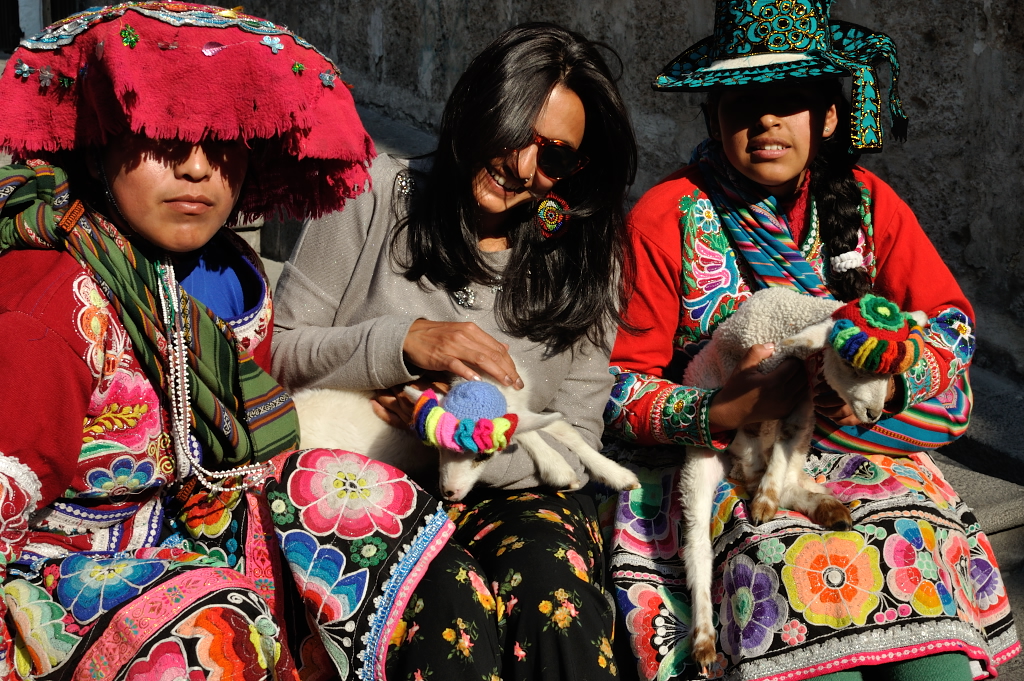
 4) Peruvian clothes and handicrafts are by far some of the most colorful I have seen. I was obsessed with the markets, and that’s coming from someone who barely does any shopping otherwise. Colorful scarves, ponchos, boots, rugs, bags, and everything in the markets had me good. One of my favorites was the Pisaq market in the Sacred Valley – learn a bit of Spanish and bargain!
5) The Rainbow flag that you will see all around Cuzco is actually the official flag of Cuzco, the sacred capital of the Inca Empire, and is NOT to be confused with the gay pride symbol. The “wiphala” flag has its origin in Inca culture and can be seen in Peru and Ecuador to represent Inca territory. The existence and use of this emblem has apparently been around for almost 2000 years. The Incas considered the rainbow a gift from god, and the famous Coricancha temple in Cuzco even has a room honoring the god of the rainbows.
 6) Peru is a dramatic mix of old and new. After the conquest of the Incas by the Spanish, the combination of the strong Spanish influence with the rich heritage of Inca culture has shaped the country’s traditions, religion, and culture. Although the majority of Peruvians are now Catholic, the Peruvian Catholicism has traditional beliefs incorporated into the practice. Churches are present in every town, however small, but the people also recognize Pachamama (Earth) and Inti (the sun-god) in their worship. It’s really a fascinating intertwining of native and modern beliefs.
 7) Peruvian gastronomy has made waves internationally, so I knew we would be eating well. What really surprised me is the breadth of flavors, ingredients, and techniques that were seen in different regions of the country. Lima definitely has the more cutting edge restaurants and chefs, whereas Cuzco and Arequipa have more traditional offerings. The food is very different region to region, based on the climate, the altitude, and the availability of ingredients. If you are an adventurous eater (I am!), try the alpaca steak, or, the cuy, which is guinea pig. Yes, guinea pig. As I mentioned earlier, potatoes, corn, and quinoa are also major players in the food world. Fruits and vegetables are beyond amazing – many fruits come from the Amazon, and the variety and flavors are mind boggling, from passionfruit to custard apple (cherimoya) to avocados, fruits here are like nothing you’ve had before! Lots of fresh juices are available in the markets, which was one of the highlights. I particularly loved San Pedro market in Cuzco.
8) Peruvians of Inca descent have jet black hair well into their 80’s, and this is all natural! I wish I had those genes! Also, the blonde and more Caucasian looking Peruvians are typically of Spanish descent.

 9) Peru is full of breathtaking photo opportunities, from the striking Andean mountains, the Amazon rainforest, snow capped peaks, historical cities, colorful people, rugged coastline, expansive Lake Titicaca, llamas and alpacas in the countryside, and so much more. The best way to enjoy it is to take it all in and put the camera away, however hard that is.
10) The Chakana symbol is seen all over Peru. This Incan cross represents 3 worlds – the upper world of gods, the middle world of our existence, and the underworld occupied by the dead. It represents the circle of life, and you will see this symbol everywhere – buildings, clothes, jewelry, and hanging around necks of the local people.
 11) The people of Peru are one of the happiest and friendliest I have come across in my travels. We saw this everywhere – from our hotel managers, restaurants owners and workers, tour guides, people on the street we asked for help from, the store owners who you bargain with, quite literally everyone, we always felt like they were genuinely happy and content with whatever they had. In our two weeks in Peru, this was the one thing that stood out consistently everywhere we went, and we came away realizing that we have a lot to learn from them.
What have you discovered on your travels? Please share in the comments!
Aparna is a DC-based blogger focusing on travel and exploring food in the places she visits, but also enjoying discovering new spots in DC. Follow her adventures via http://www.hungrytravelist.com.
 Hi! I'm the founder of Culture With Travel and #CultureTrav. Please chat with us on social media and contribute in the comments!
 Follow @Nicolette_O
